
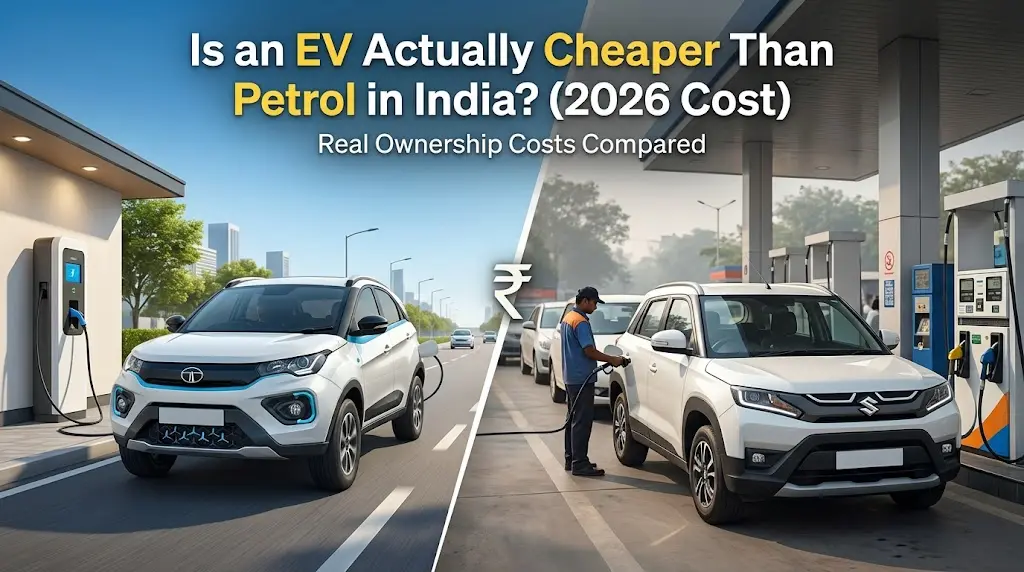
Is an EV Actually Cheaper Than Petrol in India? (2026 Cost)
The decision to switch over to an electric vehicle (EV) is not just a trend—it’s a transformative shift in the automotive landscape, especially in India. With growing environmental concerns, fluctuating fuel prices, and increasing government support, many Indian consumers are asking: “Is owning an EV actually cheaper than owning a petrol car?”
In this comprehensive guide, we’ll break down every aspect of owning an EV versus a traditional petrol car in India in 2026, including:
- Initial purchase price
- Running cost per km
- Charging vs fuel costs
- Government incentives and subsidies
- Maintenance and servicing expenses
- Charging infrastructure
- Resale value
- Long-term total ownership costs
1. The Big Question: Is an EV Cheaper Than a Petrol Car in India?
At first glance, EVs seem expensive. The battery alone adds a significant amount to the vehicle’s cost. But when you evaluate the total cost of ownership (TCO) over 5 years, including fuel, maintenance, taxes, and subsidies, the EV often turns out to be more economical.
This is especially true for the Indian market where electricity is relatively cheaper than petrol, and the government is strongly pushing the adoption of electric mobility through incentives and infrastructure support.
2. Comparing Initial Costs: EVs vs Petrol Cars
Upfront Price: The First Barrier
Traditionally, EVs have carried a higher upfront cost than petrol vehicles because of the expensive battery systems. But times are changing. With government incentives and improved manufacturing processes, this cost gap is narrowing rapidly.
Examples of popular models (2026):
Tier 1: The Entry-Level City Commuter (Budget: ₹7.5 Lakhs)
Perfect for strict city driving, daily office commutes, and effortless parking.
- Petrol Option: Maruti Wagon R / Suzuki S-Presso (Top-spec loaded variants)
- EV Option: MG Comet EV (Full Ownership / Battery Included)
| Metric | Petrol (Wagon R) | EV (Comet EV – Full Ownership) | Winner |
| Upfront Price | ₹6.5 – 6.9 Lakhs | ₹7.50 – 8.80 Lakhs (BaaS variant starts at ₹4.99L) | Petrol (Slightly lower) |
| Running Cost | ₹5.00 / km | ₹1.10 / km (Home charging) | EV (Massive savings) |
| On-Road Taxes | 8 – 10% RTO Fees | 0% Road Tax (Most states) | EV |
| Annual Fuel Bill | ₹60,000 (At 12,000 km/yr) | ₹13,200 (At 12,000 km/yr) | EV |
Tier 2: The Core Family Hatchback (Budget: ₹8 – 9.5 Lakhs)
The most popular budget bracket for everyday Indian families.
- Petrol Option: Maruti Suzuki Swift / Tata Tiago (Top trims)
- EV Option: Tata Tiago EV (Full Ownership)
| Metric | Petrol (Swift / Tiago) | EV (Tiago EV – Full Ownership) | Winner |
| Upfront Price | ₹7.5 – 8.8 Lakhs | ₹7.99 – 9.29 Lakhs | Tie (Extremely close) |
| Running Cost | ₹6.00 / km | ₹1.10 / km | EV |
| Real-World Range | 600+ km per tank | 180 – 230 km per charge | Petrol |
| On-Road Pricing | RTO taxes push it higher | 0% Road tax makes it close to ex-showroom | Tie |
Tier 3: The Micro-SUV Segment (Budget: ₹9.5 – 12 Lakhs)
For buyers wanting rugged build quality, high ground clearance, and a premium cabin.
- Petrol Option: Tata Punch ICE (Top-end premium variants)
- EV Option: Tata Punch EV (Full Ownership)
| Metric | Petrol (Punch ICE) | EV (Punch EV – Full Ownership) | Winner |
| Ex-Showroom | ₹9.0 – 10.1 Lakhs | ₹9.69 – 12.59 Lakhs (BaaS variant starts at ₹6.49L) | Petrol |
| On-Road Price | ~₹11.2 Lakhs (With RTO) | ~₹10.5 – 11.5 Lakhs (With 0% Tax benefits) | EV (On-road cost matches) |
| Running Cost | ₹7.00 / km | ₹1.30 / km | EV |
| Break-Even Point | Baseline marker | Day 1 (Since upfront on-road price aligns) | EV |
While high-end EVs like the MG ZS or Nexon EV still cost significantly more than top-end petrol SUVs, EVs in the compact and mid-range segments are now within reach of many middle-class consumers.
3. EV vs Petrol Car: Government Subsidies & Financial Incentives
When comparing an EV vs petrol car in India, the upfront cost gap can seem intimidating. However, the Government of India has introduced powerful fiscal incentives designed specifically to lower the entry barrier for electric vehicles, making the long-term financial math heavily favor green mobility.
The PM E-DRIVE Scheme (Replacing FAME-II)
While the older FAME-II initiative has concluded, the government has transitioned to the more robust PM E-DRIVE (Electric Mobility Promotion) scheme. This initiative provides substantial demand incentives directly to manufacturers, which translates to a lowered ex-showroom price for eligible electric vehicles. This significantly narrows the initial price gap in the ev vs petrol car debate.
State-Level EV Incentives
Depending on where you register your vehicle, state EV policies can dramatically alter your total savings compared to a traditional internal combustion engine (ICE) vehicle:
- Delhi & Maharashtra: Exceptional upfront incentives, along with a complete waiver on road tax and registration fees.
- Bihar: Offers direct capital subsidies of up to ₹1.5 lakh for early adopters, alongside complete road tax exemptions.
- Karnataka, Tamil Nadu, & Telangana: Substantial concessions or 100% exemptions on road tax, drastically lowering the on-road price gap between an ev vs petrol car.
The GST Advantage
One of the biggest financial differentiators when analyzing an ev vs petrol car is the tax structure:
- Electric Vehicles: Attract a minimal 5% GST rate.
- Petrol Cars: Burdened with a heavy 28% GST plus additional road cess (ranging from 1% to 22%).
Income Tax Benefits (Section 80EEB)
For individuals opting to finance their vehicle, buying an EV offers an exclusive tax shelter. Under Section 80EEB of the Income Tax Act, you can claim a deduction of up to ₹1.5 lakh on the interest paid toward your EV loan—a financial perk you will never get when purchasing a standard petrol car.
The Bottom Line: When you factor in the combined power of state road tax exemptions, minimal GST, and direct subsidies, the net on-road price gap between an ev vs petrol car shrinks down significantly right at the dealership.
4. Fuel vs Charging Costs: A Major Game Changer
Fuel costs in India are a major concern for car owners, with petrol prices averaging ₹110 per litre in 2026. EVs offer a dramatic advantage in this area.
Petrol Running Cost:
- Avg. mileage: 15–18 km/l
- Avg. petrol price: ₹110/litre
- Cost per km: ₹6.1 – ₹7.3
EV Running Cost:
- Avg. consumption: 12–15 kWh per 100 km (or 7–9 km per kWh)
- Avg. electricity cost: ₹6 – ₹8/unit (home charging)
- Cost per km: ₹1.0 – ₹1.5
Cost comparison for 1,000 km/month:
| Vehicle Type | Monthly Cost | Yearly Cost |
|---|---|---|
| Petrol Car | ₹6,500–₹7,500 | ₹78,000–₹90,000 |
| EV | ₹1,000–₹1,500 | ₹12,000–₹18,000 |
Annual savings: ₹60,000–₹75,000 just on fuel.
5. Home Charging vs Public Charging: Cost and Convenience
Home Charging:
- Most EV owners install a Level 1 (230V) charger, which gives about 32 km overnight.
- For faster charging, Level 2 (240V) chargers can fully charge a vehicle in 6–8 hours.
- Installation cost: ₹30,000–₹50,000 (can be subsidized by DISCOMs or manufacturers)
Public Charging Stations:
- Public fast chargers cost between ₹15 – ₹25 per kWh.
- While more expensive than home charging, it’s still cheaper than petrol.
- Some networks offer monthly subscription plans to reduce per-unit charges.
Charging Network Growth:
Metro cities like Delhi, Mumbai, Chennai, Bengaluru, and Hyderabad are seeing rapid expansion of EV charging infrastructure. Government initiatives and private players (like Tata Power, Ather Grid, Ola Electric, and Statiq) are fueling this growth.
Search queries show growing interest:
- “EV chargers near me”
- “Ola charging station near me”
- “EV charging rates in India”
6. Maintenance Costs: EVs Have the Edge
EVs have fewer moving parts than petrol cars. This results in:
- No engine oil or filter replacements
- Lower wear and tear
- Regenerative braking = extended brake pad life
Cost Breakdown:
| Maintenance Category | Petrol Car (₹/Year) | EV (₹/Year) |
|---|---|---|
| Engine Service & Oil | 3,000 – 5,000 | Not required |
| Air Filter & Fluids | 2,000 – 3,000 | Minimal |
| Brake & Clutch | 2,000 – 3,000 | Lower wear |
| Annual Total | ₹10,000 – ₹15,000 | ₹5,000 – ₹7,000 |
Over 5 years, an EV owner could save ₹50,000+ on maintenance alone.
7. Total Ownership Cost Over 5 Years
Let’s calculate the Total Cost of Ownership (TCO) for both an EV and a petrol car, assuming 1,000 km/month driving.
| Expense Category | Petrol Car (₹) | EV (₹) |
|---|---|---|
| Upfront Cost (after incentives) | 8,00,000 | <9,00,000 |
| Fuel/Electricity (Yearly) | 78,000 | 18,000 |
| Maintenance (Yearly) | 12,000 | 6,000 |
| Road Tax & Registration | 50,000 | 10,000 |
| 5-Year Total Ownership Cost | ₹11,40,000 | ₹10,00,000 |
Even with a higher upfront cost, an EV saves you around ₹1.4 lakh over 5 years, primarily through lower fuel and maintenance costs.
8. Battery Replacement: A Long-Term Concern?
Battery degradation is one of the few challenges in EV ownership.
- EV batteries typically last 7–10 years or 1.5 lakh km.
- Battery replacement can cost ₹3–₹6 lakhs depending on capacity.
- However, many OEMs now offer 8-year battery warranties (Tata, MG, Hyundai).
- The resale value of EVs may be affected by perceived battery health.
9. Resale Value: Still Evolving
Petrol Cars:
- Predictable depreciation curve
- Easier resale market
EVs:
- Slightly uncertain resale due to battery replacement concerns
- Growing demand and battery warranties will likely improve this
Expect the EV resale market to strengthen as adoption grows and second-hand buyers gain confidence.
10. When Does a Petrol Car Still Make Sense?
While EVs dominate in cost-efficiency, there are specific use cases where petrol cars may still be the better choice:
1. Long-Distance Travel:
Charging infrastructure on highways is still growing. Petrol cars provide better range flexibility without range anxiety.
2. Budget Constraints:
EVs may have higher upfront costs even after incentives. For tight budgets, used petrol cars offer a cheaper entry point.
3. Uncertain Resale:
If you plan to sell the vehicle in 2–3 years, petrol may hold better resale value, though this gap is shrinking.
4. Rural Areas:
Limited charging stations and inconsistent electricity supply in some rural regions still favor fuel vehicles.
11. The Future of EVs in India
India’s EV ecosystem is expanding fast:
- Battery prices are expected to drop by 40% in the next 3 years.
- Charging infrastructure is growing across cities and highways.
- Government mandates aim for 30% of all vehicles to be electric by 2030.
- Two-wheelers and three-wheelers are rapidly moving towards 100% electrification.
As technology improves and manufacturing scales, EVs will become more affordable, accessible, and reliable than ever before.
12. Is an Electric Vehicle a Worthwhile Investment for You?
If your daily commute is within city limits, and you have home charging access, an EV is a clear winner:
✅ Lower running cost
✅ Lower maintenance cost
✅ Government subsidies
✅ Cleaner for the environment
✅ Growing infrastructure
You’ll likely save ₹1–1.5 lakh over 5 years, and those savings grow if petrol prices continue to rise.
13. Final Verdict
EVs are more than just green—they’re smart economics.
While early adoption may come with a few compromises, the long-term cost savings, environmental benefits, and government support make them a better bet in most urban and semi-urban Indian contexts.
Choose an EV if:
- You drive mostly within the city
- You can charge at home
- You want to save money in the long run
- You plan to keep the car for 5+ years
Stick to a Petrol Car if:
- You drive long distances frequently
- You don’t have access to charging
- You want a predictable resale value
- Your budget is limited
Switching to an EV is no longer a futuristic dream—it’s a present-day opportunity to save, sustain, and evolve.
Want to Profit from the EV Revolution?
As the demand for electric vehicles continues to surge, there’s never been a better time to enter the EV business ecosystem. Whether you’re a budding entrepreneur or an investor looking for high-growth opportunities, the electric vehicle industry in India offers vast potential—from EV charging stations to electric bike rentals and battery swapping services. If you’re ready to be part of this clean energy movement, explore lucrative franchise options and step into the future of mobility.
👉 Discover the best EV business opportunities in India