
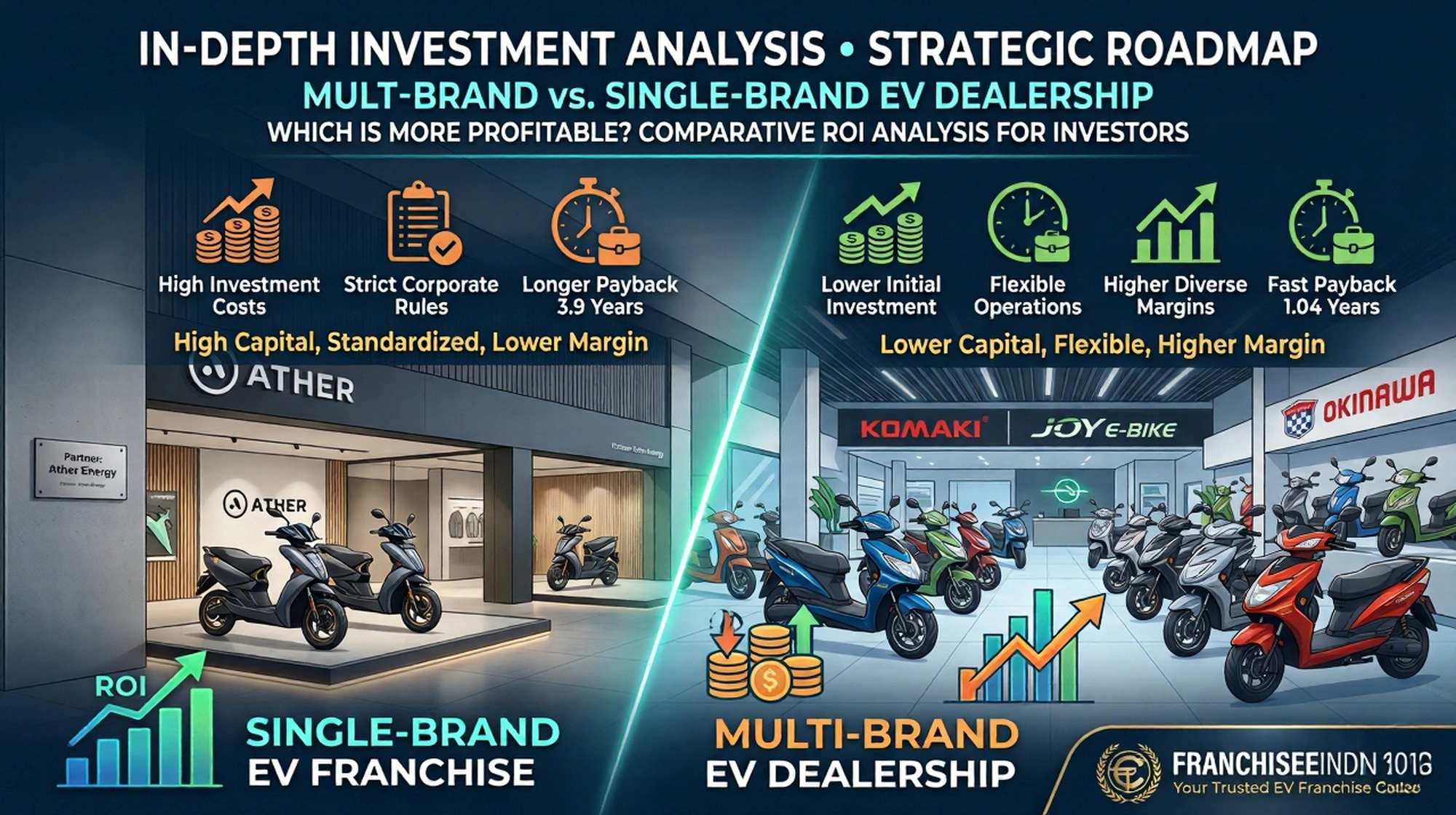
Multi-Brand vs. Single-Brand EV Dealership: Which is More Profitable? Comparative ROI Analysis for Investors
The Indian automotive ecosystem is undergoing a generational shift. Driven by government mandates, high fuel prices, and the expansion of the PM Surya Ghar Muft Bijli Yojana, electric mobility has transitioned from an eco-friendly alternative into an institutional investment goldmine. For high-net-worth individuals, automobile dealers, and corporate investors, the burning question is no longer whether to enter the green transition, but how to deploy capital for maximum return on investment (ROI).
As you plan your entry strategy, you will face a critical architectural decision: Should you invest in a single-brand EV franchise backed by a legacy Original Equipment Manufacturer (OEM) or build a diversified multi-brand EV dealership? This in-depth analysis provides a granular, data-backed comparative ROI analysis for investors targeting the 2026–2030 growth phase. By exploring the underlying financial models, operational dynamics, capital expenditure structures, and risk profiles, we will determine which framework delivers superior profitability.
1. The Structural Dynamics of EV Franchising in India
Before computing exact numbers, it is essential to understand how these two models differ operationally and legally within the domestic marketplace.
The Single-Brand EV Franchise Model
A single-brand dealership operates under a strict, exclusive corporate framework. The investor enters into a franchise agreement with a single OEM (such as Ather Energy, Ola Electric, or Bajaj Chetak). The OEM controls corporate identity, pricing mechanisms, software ecosystems, and workshop layouts. This model relies entirely on the brand equity, design language, and technology pipeline of a single manufacturer.
The Multi-Brand EV Dealership Model
Conversely, a multi-brand showroom acts as an independent aggregator. Under one roof, the dealership sells electric two-wheelers, three-wheelers, or utility micro-vehicles from various manufacturers (such as Komaki, Yakuza, Joy E-Bike, or emerging Tier-2 players). This model mirrors multi-brand consumer electronics retail outlets, giving consumers a side-by-side choice across price points, battery chemistries, and structural designs.
2. Capital Expenditure (CapEx) & EV Dealership Cost Breakdown
Setting up a dealership requires substantial upfront capital. However, the capital intensity varies dramatically between the two formats. Let us dissect the standard EV dealership cost metrics across typical setups in Tier-1 and Tier-2 cities in 2026.
| Expense Head / CapEx Component | Single-Brand EV Franchise (Tier-1 OEM) | Multi-Brand EV Dealership Hub |
|---|---|---|
| Franchise Fee / Security Deposit | ₹5,00,000 – ₹10,00,000 (Refundable/Non-refundable) | ₹1,50,000 – ₹3,00,000 (Often zero for Tier-2 brands) |
| Showroom Infrastructure & Corporate ID | ₹15,00,000 – ₹25,00,000 (Strict corporate specifications) | ₹5,00,000 – ₹8,00,000 (Flexible internal layout) |
| Advanced Workshop & Diagnostic Tools | ₹8,00,000 – ₹12,00,000 (Proprietary machinery) | ₹3,00,000 – ₹5,00,000 (Universal testing kits) |
| Initial Stock / Inventory Capitalization | ₹25,00,000 – ₹40,00,000 (Mandatory vehicle bundles) | ₹10,00,000 – ₹15,00,000 (Flexible mix based on demand) |
| Working Capital & Launch Marketing | ₹7,00,000 – ₹10,00,000 | ₹3,00,000 – ₹5,00,000 |
| Total Initial Capital Investment | ₹60,000,000 – ₹97,00,000 | ₹22,50,000 – ₹36,00,000 |
As detailed in our EV Dealership Cost Breakdown Guide, a single-brand franchise requires a massive capital outlay. This is primarily because Tier-1 OEMs mandate premium locations, high-end interior finishes, and large space allocations. In contrast, a multi-brand setup fits neatly within the Top 10 Electric Vehicle Franchise Opportunities in India under ₹15 Lakhs category if started at a compact scale, making it highly accessible for emerging entrepreneurs.
3. Revenue Stream Mapping & EV Dealership Profit Margin
An automotive dealership does not make money solely from vehicle sales. True profitability depends on cross-monetizing multiple operational channels. Let us look closely at how the EV dealership profit margin functions across these revenue streams.
- New Vehicle Sales (Front-End Margin): The direct margin earned on selling a brand-new unit.
- Spare Parts & Battery Management: Income from selling consumable parts, tires, plastic body panels, and replacement batteries.
- F&I (Finance and Insurance) Commissions: Substantial payouts from banking partners and insurance companies for every policy or loan closed at the desk.
- Value-Added Services (VAS): High-margin add-ons like extended warranties, ceramic coating, anti-theft GPS trackers, and roadside assistance subscriptions.
Single-Brand Margin Realities
Single-brand Tier-1 OEMs operate on high volume but tight percentages. Because they spend heavily on nationwide television and digital marketing campaigns, they pass thin margins down to their dealers. A typical single-brand dealer earns a front-end profit margin of just 7% to 15% per electric scooter.
Furthermore, because these vehicles rely heavily on over-the-air (OTA) software updates and centralized diagnostic tools, the OEM retains absolute control over major software renewals and complex spare parts sourcing, capping the dealer’s independent monetization avenues.
Multi-Brand Margin Dynamics
Multi-brand dealerships operate in a less restricted trade environment. Since they source directly from various regional manufacturers hungry for floor space, their bargaining power is significantly higher. The front-end EV dealership profit margin here typically scales from **11% to 16%** per vehicle unit.
Additionally, multi-brand owners can source high-quality universal spare parts, lithium-ion battery cells, and external accessories from independent component suppliers. This flexibility opens up lucrative secondary revenue lines, which we outline in detail in our blueprint on How to Open a Multi-Brand EV Service Center and Spare Parts Business.
4. Comparative ROI Analysis: 3-Year Financial Projections
To provide a definitive answer for corporate investors, we simulated a 3-year operating statement for both configurations. This model assumes a Tier-2 urban location with an average monthly sales velocity of 35 units for the single-brand showroom and 25 units for the multi-brand showroom (accounting for a slightly lower standalone brand pull per manufacturer).
Financial Simulation: Single-Brand Setup (Investment: ₹75,000,000)
- Average Unit Selling Price (Ex-Showroom): ₹1,45,000
- Monthly Sales Volume: 35 units
- Annual Sales Revenue: ₹6,09,00,000
- Blended Front-End Margin (6%): ₹36,54,000
- Ancillary Revenue (F&I, Workshop, Acc.): ₹14,50,000
- Gross Annual Revenue: ₹51,04,000
- Operational Expenses (Rent, Salaries, Electricity, Interest): ₹32,00,000
- Net Annual Operating Profit (EBITDA): ₹19,04,000
- Estimated Payback Period: 3.9 Years
Financial Simulation: Multi-Brand Setup (Investment: ₹30,000,000)
- Average Unit Selling Price (Ex-Showroom): ₹95,000 (Diversified portfolio from low-speed commuter to high-speed models)
- Monthly Sales Volume: 25 units
- Annual Sales Revenue: ₹2,85,00,000
- Blended Front-End Margin (13%): ₹37,05,000
- Ancillary Revenue (Multi-brand servicing, universal accessories): ₹11,20,000
- Gross Annual Revenue: ₹48,25,000
- Operational Expenses (Lower space/marketing mandates): ₹19,50,000
- Net Annual Operating Profit (EBITDA): ₹28,75,000
- Estimated Payback Period: 1.04 Years
Key ROI Takeaway for Investors
While the single-brand franchise generates larger top-line gross numbers due to its higher average product selling price and institutional brand pull, the multi-brand dealership shines in bottom-line profitability. Its lower operating expenses, combined with nearly double the front-end sales margin, allow investors to break even in roughly one-third of the time required by a single-brand setup.
5. Risk Profiling: Market Vulnerabilities & Operational Control
A smart investor evaluates more than just profit projections; they carefully analyze structural risk. Both business models carry distinct vulnerabilities that can severely impact operational continuity.
Supply Chain and Product Recall Risk
A single-brand franchise is completely exposed to the operational stability of its parent OEM. If the manufacturer faces vehicle delivery delays, software glitches, battery thermal runaway incidents, or high-profile vehicle recalls, the dealership’s sales instantly drop to zero. The dealer cannot pivot to another product because they are bound by an exclusivity clause.
A multi-brand showroom mitigates this supply chain risk through product diversification. If Brand A suffers production delays or regulatory issues, the dealer simply shifts floor space, sales focus, and local marketing capital to Brand B and Brand C. This portfolio design protects cash flow from single-source failures.
Regulatory Compliance and Policy Adjustments
The electric vehicle industry in India remains highly sensitive to government subsidy changes, such as adjustments to the FAME framework or EMPS (Electric Mobility Promotion Scheme) allocations. Tier-1 premium electric vehicles often depend on these subsidies to justify their high costs to consumers. Any sudden drop in subsidy incentives can cause a temporary drop in customer demand.
Multi-brand showrooms usually balance their inventory with low-speed electric two-wheelers that do not require RTO registration or deep government subsidies. This low-speed category provides a stable, recession-proof revenue baseline from delivery fleets, student commuters, and hyper-local delivery partners.
6. Strategic Evaluation Matrix: Making the Final Decision
To help you choose the path that best matches your investment portfolio, capital limits, and long-term vision, use this quick reference evaluation matrix:
| Evaluation Parameter | Single-Brand EV Franchise | Multi-Brand EV Dealership Hub |
|---|---|---|
| Capital Risk Level | High (Heavy fixed capital commitment) | Low to Moderate (Highly fluid asset structure) |
| Customer Acquisition Cost (CAC) | Low (Driven by OEM’s national advertising) | High (Requires localized marketing efforts) |
| Operational Control | Minimal (Dictated by corporate SOPs) | Absolute (Owner sets pricing, brands, and policies) |
| Long-Term Valuation / Exit | High (Transferable corporate asset) | Moderate (Dependent purely on local cash flow) |
| Target Consumer Base | Premium buyers, tech enthusiasts | Value-conscious riders, commercial delivery fleets |
7. The Service and Infrastructure Multiplier
Regardless of the showroom model you choose, the future of EV profitability is deeply tied to back-end infrastructure. Forward-thinking investors are multiplying their returns by integrating charging networks directly into their retail spaces. As covered in our comprehensive EV Charging Station & Battery Swapping Franchise Application Hub, adding dual-gun fast DC chargers or modular battery swapping docks (partnering with networks like Exide, Amaron, or Sun Mobility) creates a steady stream of recurring foot traffic. This infrastructure transformation turns a static showroom into a dynamic energy destination, capturing high-margin B2B fleet accounts while accelerating new vehicle sales.
8. Conclusion and Final Investment Verdict
Choosing between a multi-brand EV dealership and a single-brand franchise comes down to your capital layout strategy and risk tolerance.
If you are an institutional investor seeking high long-term asset valuation, possess deep capital reserves (₹70+ Lakhs), and want to build a premium business aligned with a top-tier automotive brand, the **Single-Brand EV Franchise** remains a solid choice. The longer payback period is offset by structured corporate support, automated lead generation, and high brand equity.
However, if your primary investment goals are **maximizing immediate cash-on-cash ROI, maintaining flexible operations, avoiding strict corporate oversight, and achieving a fast break-even period**, the data shows that a **Multi-Brand EV Dealership** is the more profitable choice. It lets you capture the largest, most cost-sensitive segments of the Indian electric vehicle market while keeping your risk low through product diversification.
Next Actionable Steps for Investors:
1. Assess your available investment capital. If it falls below ₹25 Lakhs, prioritize building a localized multi-brand network.
2. Review our extensive practical breakdown: How to Start an Electric Scooter Dealership: The Ultimate Step-by-Step Guide to learn about municipal license approvals, fire safety rules, and how to successfully file your application online.
3. Connect with regional battery distributors by reading our EV Battery Dealership Application Guide to secure high-margin component supply agreements before breaking ground on your showroom floor.