
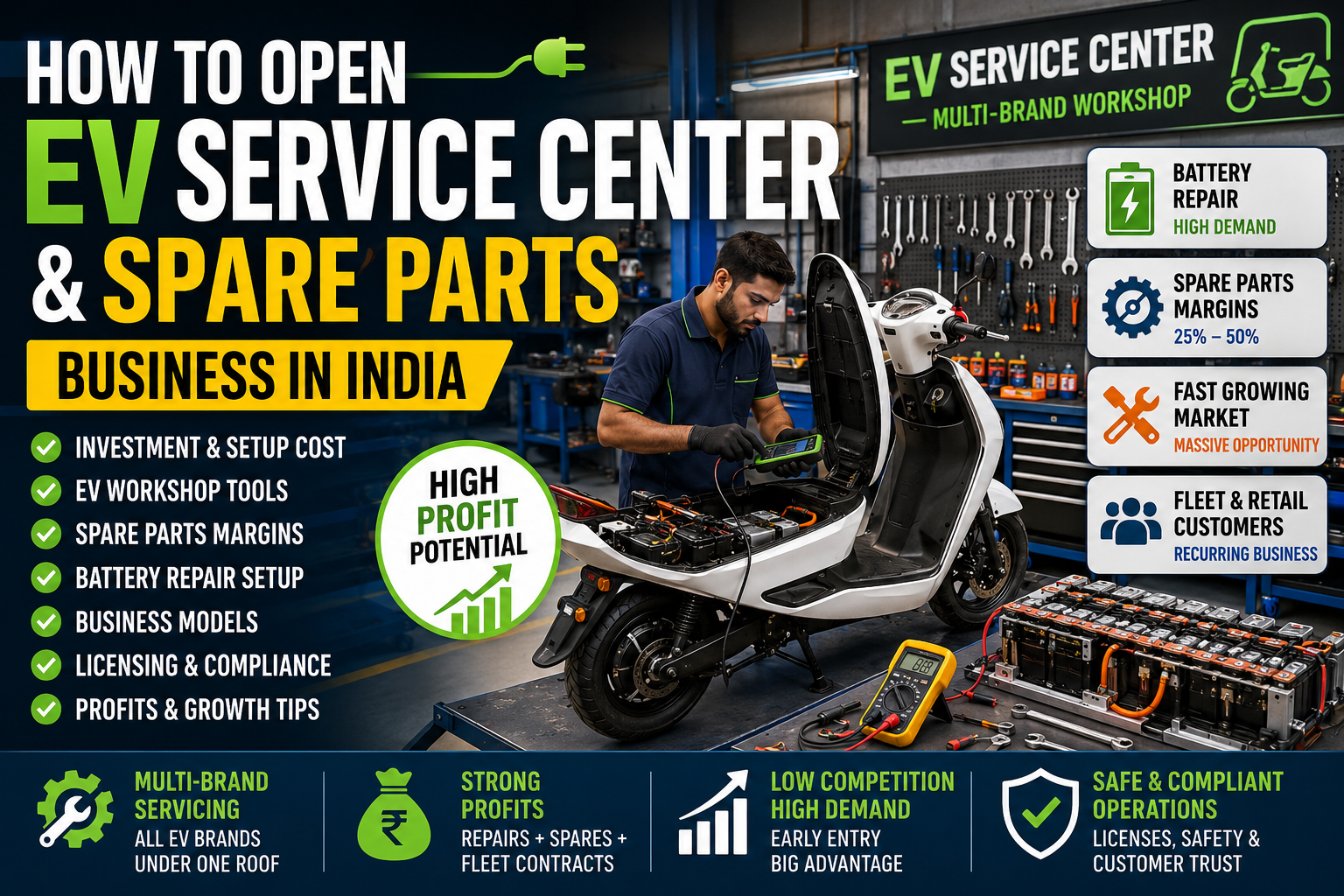
How to Open a Multi-Brand EV Service Center and Spare Parts Business in India
India’s EV market is growing faster than the servicing ecosystem. Electric scooters, e-rickshaws, and low-speed EVs are entering every town, but customers still struggle to find quick repairs and genuine spare parts. That gap is creating a massive opportunity for local mechanics, garage owners, and workshop entrepreneurs.
If you are researching how to open EV service center operations in India, this is one of the best times to enter the market. Most EV companies are focusing heavily on sales while independent workshops are handling actual ground-level servicing.
Customers today care more about quick repair than brand logos. Delivery riders, fleet operators, and daily commuters cannot wait 10 days for dealership appointments. Local workshops solving battery, controller, charger, and motor issues quickly are quietly building profitable businesses.
Why Multi-Brand EV Workshops Are Growing Fast
The electric scooter repair business is expanding rapidly across tier-2 and tier-3 markets. Smaller cities now have hundreds of electric scooters but very limited service infrastructure.
- Long dealership service delays
- Battery load issues
- Controller failure complaints
- Spare parts shortages
- Delivery rider downtime
- Limited trained technicians
This is why the EV mechanic business model is becoming attractive even for traditional roadside garages. Existing mechanics already understand brakes, suspension, wheel alignment, bearings, and electrical wiring. The major upgrade required is EV diagnostics and lithium battery understanding.
Business Models in the EV Aftermarket
A. EV Service & Diagnostics Workshop
A multi-brand EV workshop setup can offer:
- Controller diagnostics
- Battery troubleshooting
- Motor servicing
- Software calibration
- Charging fault repair
- Wiring inspection
- Water damage repair
Most workshops today earn strong margins from controller replacement, charger repairs, and software-related faults.
B. EV Spare Parts Business India
The EV spare parts business India segment is growing because independent workshops need fast-moving inventory regularly.
- Chargers
- BMS units
- Controllers
- Display clusters
- Brake sensors
- Throttle assemblies
- DC converters
Workshop owners supplying nearby garages often create an additional wholesale income stream beyond servicing revenue.
C. EV Battery Repair Business
The EV battery repair business is expanding because replacement batteries are expensive. Customers prefer repairing battery packs whenever possible.
- Lithium cell replacement
- BMS repair
- Battery balancing
- Thermal issue inspection
- Connector replacement
Battery repair requires trained technicians and proper safety handling because lithium batteries can become dangerous if repaired carelessly.
EV Garage Investment Cost Breakdown
Basic Workshop Setup
| Expense Head | Estimated Cost |
|---|---|
| Shop Deposit & Rent | ₹80,000 – ₹1.5 lakh |
| EV Workshop Tools | ₹70,000 |
| Battery Diagnostics Equipment | ₹60,000 |
| Initial Spare Inventory | ₹1 lakh |
| Electrical Setup | ₹40,000 |
| Working Capital | ₹1 lakh |
Estimated Investment
₹4 – ₹6 Lakh
Medium Multi-Brand EV Workshop Setup
| Expense Head | Estimated Cost |
|---|---|
| Commercial Setup | ₹2 – ₹3 lakh |
| Advanced EV Workshop Tools | ₹2 lakh |
| Battery Repair Equipment | ₹2 lakh |
| Spare Inventory | ₹3 lakh |
| Staff & Training | ₹1 lakh |
| Working Capital | ₹2 lakh |
Estimated Investment
₹12 – ₹15 Lakh
Best EV Workshop Tools Required
Professional workshops require proper EV diagnostics tools India suppliers are now providing.
- Digital multimeters
- Insulation testers
- Battery analyzers
- Thermal scanners
- Controller flashing tools
- Hydraulic lifts
- Software diagnostic systems
Without proper EV workshop tools, fault detection becomes guesswork and customer trust suffers.
Most Profitable EV Spare Parts
| Spare Part | Profit Margin | Demand Level |
|---|---|---|
| Controllers | 25% – 40% | Very High |
| Chargers | 20% – 35% | Very High |
| BMS Units | 30% – 45% | High |
| Throttle Assemblies | 25% – 50% | High |
| Display Clusters | 20% – 35% | Medium |
| Motors | 15% – 25% | Medium |
| Brake Sensors | 30% – 50% | High |
Licensing & Compliance
Before starting your EV scooter service workshop, ensure proper business registrations and safety compliance.
- GST registration
- Trade license
- Commercial electricity connection
- Fire NOC
- Business insurance
- Battery storage safety setup
Lithium battery storage areas should remain dry, ventilated, and protected from overheating.
Challenges Most Mechanics Ignore
The EV aftermarket business opportunity is profitable, but many workshops fail because they underestimate operational problems.
- Cheap imported spare parts
- Software compatibility issues
- Battery fire risks
- Technician shortages
- Customer warranty disputes
- Supply chain delays
The workshops succeeding today are focusing on technical skill, proper tools, and customer trust instead of shortcuts.
Future Growth Opportunity
India’s EV aftermarket is still in an early growth phase. Rising delivery fleets, e-commerce expansion, and battery replacement cycles will continue increasing demand for EV servicing.
Tier-2 and tier-3 cities especially have massive demand because dealership infrastructure remains limited. Workshops entering the market early are building long-term customer loyalty.
Start Your EV Workshop Before the Market Gets Crowded
Independent EV workshops are becoming the backbone of India’s electric mobility ecosystem.
Frequently Asked Questions
A small EV workshop can start from ₹4–6 lakh. Medium-sized multi-brand EV workshops usually require ₹12–15 lakh depending on tools, spare inventory, and shop size.
Yes. Since replacement batteries are expensive, many customers prefer repairing lithium packs through BMS repair and cell replacement services.
Controllers, BMS units, chargers, brake sensors, and throttle assemblies currently offer strong EV spare parts profit margins in India.
Yes. Mechanics should understand lithium battery safety, controller diagnostics, insulation testing, and EV software calibration before starting.
Absolutely. Tier-2 and tier-3 cities have rising EV adoption but limited dealership service infrastructure, creating strong demand for local workshops.