
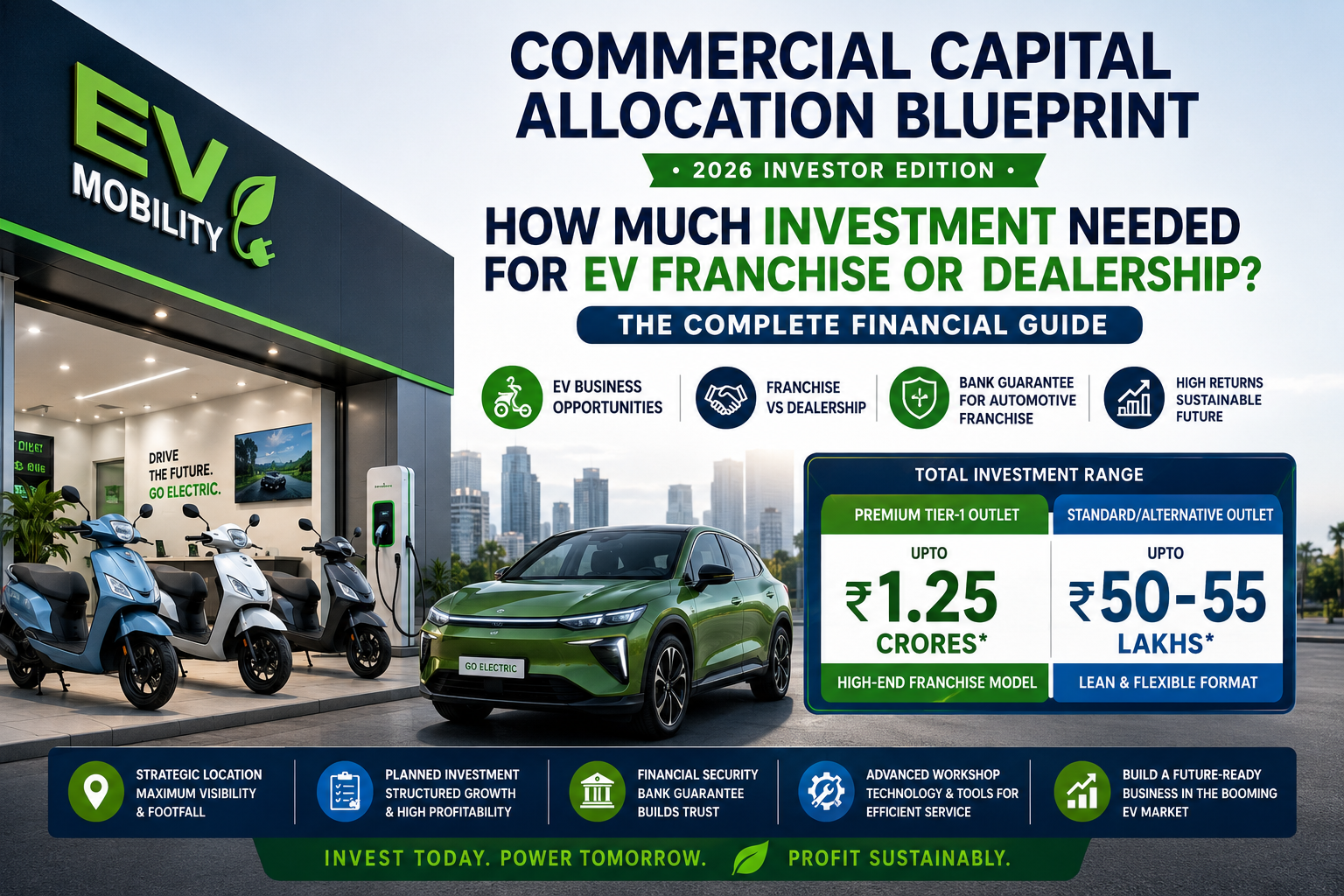
How Much Investment Needed for EV Franchise or Dealership? The Complete Financial Guide
The green transition across the Indian subcontinent has officially evolved from a novel sustainable initiative into a high-yielding corporate infrastructure play. As traditional fuel prices remain volatile and consumer habits shift heavily toward electric mobility, clean energy commerce is experiencing an unprecedented boom. This shift is highly accelerated by the reality of long-term economic savings, where running expenses drop down dramatically to just ₹1.0 to ₹1.5 per kilometer compared to traditional internal combustion engines[cite: 1]. Driven by these margins, investors are aggressively competing to anchor regional distribution nodes. However, deploying capital efficiently requires a transparent, unvarnished look at the exact upfront numbers.
Entering the electric vehicle retail landscape demands absolute financial clarity. Vague estimations frequently lead to severe working capital shortages within the first year of operation. This document delivers an exhaustive, line-by-line financial roadmap detailing the exact investment needed for EV franchise setups or independent commercial dealerships in 2026. From brand capitalization deposits and high-end retail interior layouts to workshop tool deployment and back-end security frameworks, we map out the complete capital requirements needed to build a resilient, highly profitable enterprise.
1. The Structural Difference Between an EV Franchise and an EV Dealership
Before allocating liquid capital to lease agreements or inventory pools, an investor must understand the operational and legal framework governing their business model. While often used interchangeably, there is a distinct difference between EV franchise and EV dealership models regarding corporate autonomy, risk management, and profit distribution.
The EV Franchise Framework
An EV franchise is a tightly controlled corporate partnership. Under this alignment, the corporate entity (the franchisor) grants the investor the right to operate under an established trademark, utilizing an identical corporate layout, standardized technology suites, and pre-determined pricing algorithms. The franchisor frequently exercises strict control over the site selection process, interior aesthetic compliance, and diagnostic mechanisms. The primary benefit is access to immediate, national brand pull and structured corporate marketing support, though it comes at the expense of independent operational flexibility.
The EV Dealership Framework
An EV dealership functions as a merchant-distributor network. While the dealer still operates in alignment with manufacturing agreements, they maintain a substantially higher degree of local administrative autonomy. Dealerships typically purchase vehicle inventory outright from one or multiple manufacturing lines and enjoy greater control over localized promotions, trade setups, and localized pricing structures. This model is highly favored by veteran automotive entrepreneurs who wish to build a localized retail legacy without answering to strict, micromanaged corporate SOPs.
2. Pre-Operational Expenditures: Application Fees & Regulatory Compliance
Your initial capital allocation occurs long before the first vehicle rolls onto your showroom floor. Securing distribution territory rights mandates immediate, non-negotiable financial outlays.
Brand Sign-On Fees and Security Deposits
To lock down regional exclusive rights within a specific municipality or pincode, top-tier legacy manufacturers require an upfront franchise or dealership security fee. Depending on the brand’s national footprint and consumer demand, this initial brand application fee ranges from ₹5,00,000 to ₹10,00,000. This capital is typically used by corporate entities to cover initial technical training, dealership onboarding kits, and proprietary cloud-based dealership management software setups.
Statutory Licensing, Grid Upgrades, and Clearances
Securing green-lit commercial space requires navigating localized bureaucratic channels. To successfully secure a valid municipal Trade License, State Pollution Control Board clearances (mandated for battery storage protocols and service wash bays), and strict Fire Department NOCs, expect a dedicated line-item allocation of ₹1,50,000 to ₹2,50,000. Furthermore, establishing high-capacity grid connectivity with local state electricity distribution nodes requires dedicated commercial meter security deposits and 3-phase high-load transformer configurations, commanding an average investment of ₹2,00,000.
3. Real Estate Layout: Rental Deposits & Spatial Configuration
Your physical location serves as your primary customer acquisition tool, but it also represents your highest fixed monthly liability. Commercial parameters vary based on the specific vehicle classification you choose to distribute, though general space trends for 2-wheeler and 3-wheeler layouts remain uniform across expanding urban hubs.
The Lease Allocation Advance Blueprint
A standard electric vehicle outlet requires a minimum physical footprint of 1,200 to 2,500 sq. ft., cleanly segmented into a polished front-end customer interaction lounge and an insulated, back-end technical service bay. Commercial landlords typically demand a **6-month rental advance security deposit prior to handed-over keys. Assuming average premium high-street lease metrics ranging from ₹80 to ₹150 per sq. ft., your initial real estate deposit layout demands a capital reserve of ₹4,50,000 to ₹12,00,000.
4. Detailed Line-Item Cost Structure: Showroom Interiors & Workshop Tech
Corporate identity compliance represents a major segment of your upfront fixed asset deployment. Manufacturers enforce highly specific visual parameters to maintain global identity coherence.
| Specific Infrastructure Cost Head | Premium Tier-1 Brand Specifications | Standard/Flexible Retail Formats |
|---|---|---|
| High-End Toughened Glass Frontage & Facade | 3,50,000 – 5,00,000 | 1,80,000 – 2,50,000 |
| Vitrified Flooring & Anti-Static Tech Bay Tiles | 2,50,000 – 4,00,000 | 1,20,000 – 2,00,000 |
| Premium LED Lighting, Central Air Conditioning (HVAC) | 5,00,000 – 7,50,000 | 2,50,000 – 4,00,000 |
| Corporate Exterior Signage, Illumination, & ACP Panels | 4,00,000 – 6,00,000 | 1,50,000 – 3,00,000 |
| Customer Experience Lounges, Desks, & Digital Kiosks | 3,00,000 – 5,50,000 | 1,00,000 – 2,00,000 |
| Subtotal: Showroom Interior Infrastructure | 18,00,000 – 28,00,000 | 8,00,000 – 13,50,000 |
Advanced Workshop Tooling and Equipment Capitalization
When analyzing the total EV dealership cost framework, the back-end mechanical bay represents a significant investment block. Unlike traditional combustion engine workshops that depend on fluid-exchange drainage systems, electric vehicle diagnostic bays run purely on electronic testing infrastructure.
Your capital plan must explicitly budget for heavy-duty pneumatic lifts (minimum 3 bays = ₹2,50,000), localized digital lithium battery health monitors (₹1,80,000), universal ECU software scanning terminals, insulation testing safety kits, and specialized non-conductive mechanic toolkits (₹3,00,000). This combines into a total technical workshop asset deployment costing ₹7,30,000 to ₹12,00,000.
5. Supply Chain Funding: Initial Stock Allocation & Inventory Turnover
Inventory capitalization is a highly dynamic financial metric. This is where your liquid cash is converted into physical, high-velocity assets destined for localized retail fulfillment.
To qualify for launch-phase inventory dispatches, parent brands mandate a minimum opening vehicle stock purchase. For a standard electric two-wheeler operation, this introductory lot is typically pegged at 25 to 40 complete units. Calculating an average institutional ex-factory billing cost of ₹1,10,000 per vehicle, your base upfront stock acquisition requires a liquid layout of ₹27,50,000 to ₹44,00,000.
Additionally, you must set aside ₹3,50,000 for localized fast-moving spare parts (including electronic throttle sensors, display screens, braking assemblies, and outer body panels) to ensure your service division can resolve client maintenance requests instantly.
6. Understanding the Bank Guarantee Safety Net
A critical component within the roadmap of starting an electric scooter dealership that catching many rookie investors off-guard is the requirement of a formal corporate bank guarantee.
What is an Automotive Bank Guarantee (BG)?
A Bank Guarantee is an institutional, legally binding financial instrument issued by a tier-1 commercial bank on behalf of the retail owner, favoring the parent manufacturer. It serves as a secondary security block ensuring that if the dealer defaults on high-value parts allocation credit, inventory financing agreements, or warranty settlements, the bank will cover the corporate liabilities immediately.
To allow a seamless flow of continuous inventory dispatches without requiring hard cash bank transfers prior to every single delivery truck leaving the factory, top-tier automotive brands demand a standing bank guarantee for EV franchise alignments ranging from ₹15,00,000 to ₹30,00,000.
To successfully establish a BG via institutions like State Bank of India, HDFC, or ICICI Bank, you are required to deposit 100% hard cash collateral or liquid fixed deposits within the branch, or pledge completely unencumbered commercial real estate assets. Because this asset block stays completely locked throughout the duration of your franchise agreement, it cannot be touched for daily operational liquidity.
7. Working Capital Management & Launch Marketing Launchpads
A significant portion of automotive showrooms collapse within their inaugural year not due to a lack of buyer interest, but due to structural working capital exhaustion. Your asset map must preserve a distinct cash runway to handle fixed monthly overheads before the business reaches a natural self-sustaining break-even velocity.
The 6-Month Operational Working Capital Buffer
Your reserve funding must absorb fixed operational liabilities for a minimum of two full quarters without relying on vehicle unit sales revenue. A typical monthly burn profile for a mid-scale urban EV hub includes:
- Commercial Real Estate Lease Expenses: ₹1,00,000 – ₹1,80,000
- Human Capital Payroll (Showroom Manager, Sales Advisors, Certified Technicians, Accountant): ₹1,20,000 – ₹1,80,000
- Commercial Utilities (High-Capacity 3-Phase Charging Grids, CRM Tech, Maintenance): ₹35,000 – ₹60,000
Consequently, maintaining an ironclad 6-month operational survival cushion requires a minimum of ₹15,30,000 to ₹25,20,000 sitting purely liquid in your corporate checking account.
Pre-Launch Localized Marketing and Hyper-Local Lead Sourcing
To cultivate an active client waiting list prior to the official ribbon-cutting ceremony, you must deploy an aggressive local promotional campaign. Initial capital spent across localized Google Maps SEO, highly targeted Meta lead generation loops, and major localized outdoor physical banners requires a launch budget allocation of ₹2,00,000 to ₹4,00,000.
8. Comprehensive Investment Summary Matrix
To assist in your corporate budgeting sessions, here is the consolidated financial blueprint outlining the total EV showroom investment capital metrics across different target entry levels:
| Line-Item Capital Component | Premium Tier-1 Capital Layout (INR) | Standard/Alternative Format Layout (INR) |
|---|---|---|
| Franchise/Dealership Application Deposit | 8,00,000 | 2,00,000 |
| Real Estate Lease Security Deposit (6-Mo Advance) | 9,00,000 | 4,50,000 |
| Showroom Interior Fit-Outs, Structural Glass, & Facade | 22,00,000 | 10,00,000 |
| Pneumatic Workshop Lifts & Electronic Diagnostics | 9,50,000 | 5,00,000 |
| Opening Vehicle Stock & High-Velocity Spare Parts | 35,00,000 | 14,50,000 |
| Pledged Bank Guarantee (FD/Cash Asset Lock) | 20,00,000 | 5,00,000 (Often Waived) |
| 6-Month Operational Working Capital Cash Buffer | 18,00,000 | 10,50,000 |
| Statutory Licensing & High-Load Grid Transformer Setup | 4,00,000 | 2,00,000 |
| Grand Total Capital Deployment Target | 1,25,50,000 | 53,50,000 |
9. Conclusion: Strategic Next Steps for Institutional Investors
Securing a position within the green energy retail network represents one of the most lucrative commercial electric vehicle business opportunities available over the next decade[cite: 2]. However, entering this arena requires structural financial planning. To launch a premium, high-tier outlet successfully, an investor must clear a realistic capital threshold of ₹1.25 Crores. Alternatively, executing a leaner, alternative retail structure can be achieved with a total financial footprint of ₹50 Lakhs to ₹55 Lakhs if managed with strict asset-light constraints.
Immediate Actionable Checklist:
1. Confirm that your target commercial real estate plot possesses clear title documentation explicitly approved for automotive retail and mechanical service by local municipal bodies.
2. Request a preliminary solvency certificate from your primary banking partner to ensure rapid processing of your upcoming bank guarantee for EV franchise alignments.
3. Finalize your budget boundaries to decide whether your capital structure aligns with a strict corporate franchise system or an independent dealership design before initiating formal corporate outreach channels.